[00:00:10] Ray Latif: Hello, and thanks for tuning in to Taste Radio, the number one podcast for anyone building a business in food or beverage. I'm Ray Latif, the editor and producer of Taste Radio, and I'm with my co-host for this episode, John Craven, Melissa Traverse, and Mike Schneider. Is Better Sour becoming the new default? This week, we dig into the explosion of functional candy and other health-focused snacks, unpack the latest data on where CPG investors are putting their money, and examine why protein-packed, diet-free, and ingredient-conscious startups continue to attract funding despite a challenging capital market. We also dive into the next wave of innovation in food and beverage, including mushroom lemonade, snacking croutons, and tinned protein bars. Welcome back to the studio, John Craven. Two weeks in the WCB, the West Coast branch, or at least in the area of the West Coast branch. Yeah, the area of. The area of, that's San Diego.
[00:01:08] John Craven: Yeah. I love your precision sometimes, Ray.
[00:01:11] Ray Latif: Yeah. Well, did you, uh, did you get to visit any other parts of Southern California or was it just, uh, San Diego? LA. You went to LA? Okay. I did. Oh, what'd you see there? Air One. Did you really?
[00:01:21] Melissa Traverse: Yeah.
[00:01:22] Ray Latif: Did you get some of their new water?
[00:01:24] Melissa Traverse: Oh, the hose water, no. I also saw my favorite LA area hotel, the Marriott Marina Del Rey, which, Ray, you should inform our listeners the context of that.
[00:01:39] Ray Latif: Yes, the Marriott Marina Del Rey is hosting BevNET CPG Media's live events in December, including, of course, BevNET Live, Nosh Live, and Brewbound Live. To learn more about all three of those events, head to their respective websites.
[00:01:53] Mike Schneider: That's going to be here before you know it.
[00:01:54] Ray Latif: Which are like BevNetLive.com, NoshLive.com, and BrewBoundLive.com? Those are the ones. Oh, thanks, Ray. Yeah. Yeah. I like when I get it right.
[00:02:01] Mike Schneider: Good information.
[00:02:02] Ray Latif: We have an event that's coming up even sooner than that. That's the Taste Radio Chicago Meetup, which is happening on August 13th in Logan Square at Pilot Project Brewing, 5 to 7.30 PM. If you are in the Chicago area or visiting, we want to see you there. Just head to Taste Radio.com slash meetups to RSVP. Once again, we need to know how many people are coming so we can order enough Sloppy Joe sandwiches for everyone.
[00:02:27] John Craven: Who's supporting that event, Ray?
[00:02:28] Ray Latif: The folks that are supporting that event are the Angel Group, Belay, and Vibrant Ingredients. They are national partners for our entire series. Thank you. Which also includes our upcoming meetups in San Diego, San Francisco, and London. More details on all three of those events, once again, at Taste Radio.com slash meetups. Good stuff. Good stuff indeed. You know what else is good stuff? Better Sour candy. Everyone seems to think that Better Sour Candy has a future, including the New York Times. There was an article recently penned on that legacy media publication called, Who Put Candy On A Diet? Healthy confections, whether marketed as Better Sour or functional, have overwhelmed grocery and convenience stores and even found their way into gyms and supplement shops. Overwhelmed grocery and convenience stores? I wouldn't say that.
[00:03:27] Mike Schneider: I would say they've made an entry, but.
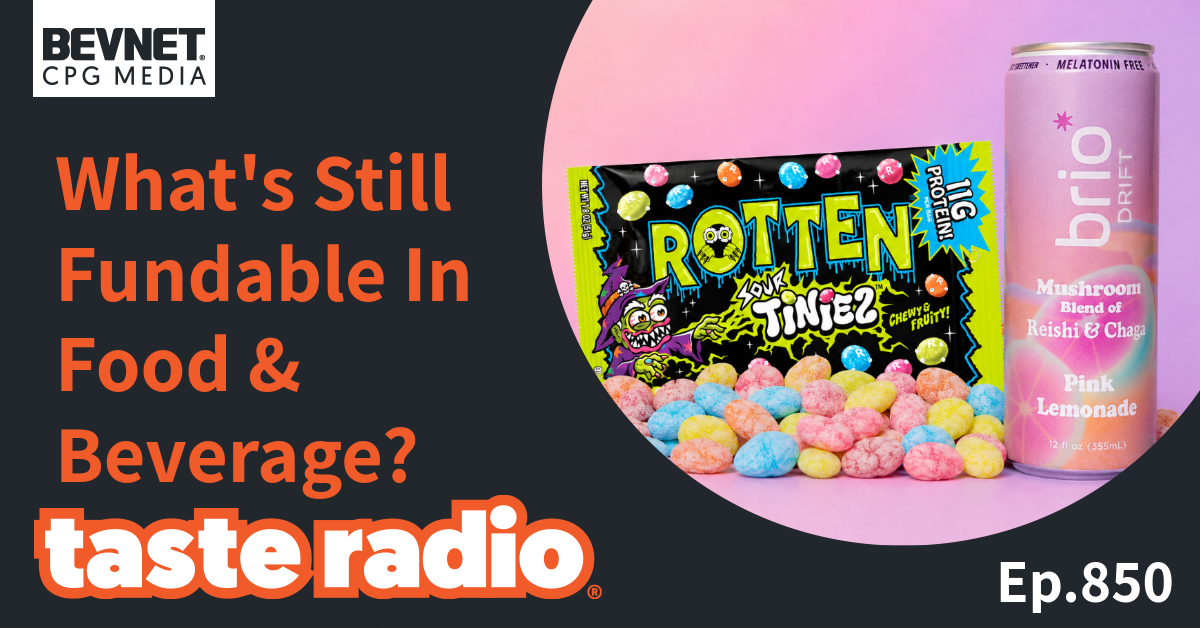
[00:03:30] Ray Latif: Definitely feels like people love candy and people have been looking for Better Sour versions, whether they are lower in calories, lower in sugar, have some sort of gut health benefit, protein benefit. Protein benefit? Who puts protein in candy? I don't know. You know who puts protein in candy? Rotten. R-O-T-T-E-N is the name of the brand. Best known for their. Wine of the Pishlam? Winner of the Nosh Pitch Slam. Well done, John Craven. Winner of the Nosh Pitch Slam in 2025. Here. Oh, and we have even more candy coming here.
[00:04:01] Mike Schneider: Aw, thanks, Colin. Special delivery by... It's not Colin, it's Jake. Thank you so much. Thank you.
[00:04:08] Ray Latif: Yes. I wouldn't call him Faye Colin. He's...
[00:04:11] Mike Schneider: Trying to give you a recovery there.
[00:04:14] Ray Latif: Can't see behind those cameras.
[00:04:15] Mike Schneider: No, I know. I couldn't see. Couldn't see.
[00:04:17] Ray Latif: Yeah. Rotten was founded by Michael Fisher. And as John mentioned, the winner of Nosh's Pitch Slam in 2025. Best known for their spicy gummies. Spicy and sweet. But they recently introduced a couple new lines of products that are reminiscent of traditional legacy brands. One of them rhymes with kittles, and another one rhymes with barbursts.
[00:04:47] Mike Schneider: I wonder what those could possibly be.
[00:04:49] Ray Latif: Does it also rhyme with carwursts? So Rotten's Kittles alternative is called Original Tiniez, but it's spelled T-I-N-I-E-Z, and they contain 11 grams of protein per bag. How about that?
[00:05:03] John Craven: That's quality.
[00:05:03] Ray Latif: Yeah. And then there are barburst alternatives. Also contain a lot of protein 11 grams per bag and they described as having 50 cent percent less sugar Well one variety past 50 cent percent less sugar than the leading brand the other one has 50% than the leading brand What's the leading brand I think it rhymes with? barburst I Was doing that until I got the ah from John so I got it sorry
[00:05:31] Mike Schneider: I have to say they do a really good job with the flavor here. And that to me is the most important thing.
[00:05:37] Ray Latif: So these Original Tiniez's are insane. They are like, what's the word? Crack. You know, everyone talks about stuff being crack. Yeah, sure. Yeah. I just, just full disclosure here. I've never had crack in my life, so I can't necessarily say that as a truth, but these are really delicious. What's so funny?
[00:05:55] John Craven: I was just thinking about you saying tastes like shit too, because you've said that before.
[00:06:01] Ray Latif: on this podcast. But yeah, these are really, really great alternatives to the quote unquote real thing. In fact, I think I like these even better. I'm not sure if I like them better because they have protein in them. Honestly, I think I like them better because they just taste better. Truthfully.
[00:06:17] Mike Schneider: Are those the sour?
[00:06:18] Ray Latif: These are the Original Tiniez. Okay. Yes. I haven't had, I was holding and waiting Until we all were here to eat these sour chewers. These are the barbers alternatives. They're called chewers. C-H-E-W-E-R-Z. I'm going to get into the sour ones. It keeps reminding me that I need a haircut. I'm at it. You didn't get a haircut yet for Taste Reader Chicago?
[00:06:45] John Craven: I need one, yeah. Thanks for reminding me with the bar bursts.
[00:06:47] Melissa Traverse: Have you guys had these before, yet, or no?
[00:06:49] Ray Latif: Yeah.
[00:06:49] Melissa Traverse: I got some hand-delivered when I was in San Diego.
[00:06:52] Ray Latif: I thought we were all gonna wait together to eat them. Look at Ray hoard them. No, I did not hoard them.
[00:06:56] John Craven: Look at him, he's holding them right now.
[00:06:58] Ray Latif: He's opening one for himself. He hasn't even passed the bag around. What's great about this also is that the colors are from fruits, veggies, and superfoods, and when you unwrap the loopy lime variety, And you look at it, it doesn't have that neon green color that some other candies do. It actually looks like a kiwi almost, right? Like it looks like the inside of a kiwi.
[00:07:21] John Craven: Yeah, sure.
[00:07:22] Melissa Traverse: Thumbs up from Ray.
[00:07:23] Ray Latif: The texture is spot on. Flavor is really good. I think they nailed it. Well done, Rotten. Well done, Michael Fisher. And well done to our dear friend, Adam Hertel, who is heading up sales for the company. And I know he wanted to make sure that we got these. So we got great stuff. We got them. Thank you.
[00:07:44] Mike Schneider: I got this Happy Candy in the mail. I don't know if you guys have tried these, but these Yeah, they're really tasty. They're gummy, 70% less sugar. These also have fiber, seven grams of fiber. What I really like about these is that they don't have any alternative sweeteners in them. The thing that bugs me about the Better Sour You candy is that cloying, whether it's stevia or allulose or whatever it is. But I think these are incredibly tasty and you don't get that kind of side of hurting the side, you know, the back of your jaw with alternative sweeteners. And I think they taste perfectly sweet.
[00:08:19] Ray Latif: Yeah, great job by founder Maxi Heidenblut, who we featured on Elevator Talk. I want to say it was five or six months ago, and I really enjoyed eating this product for the same reasons that Melissa described, is they don't contain any other alternative low caloric sugars. They just are what they are. They're really reminiscent of a European-style candy, European-style gummy. And I think that's what Maxi, who is a native of Germany, was going for. Happy Candy also, as reported by our very own Shauna Golden, has made its Whole Foods debut in select Northeast and South Pacific stores. So big, big news for Happy Candy. Great job once again, Maxi.
[00:09:05] John Craven: I like all the ingredients that she's using for color. Turmeric, spirulina, carrot extract for color.
[00:09:12] Mike Schneider: Yep, I have the Italian summer skew here, which I think is an interesting way to name a candy skew. It's lemon and sherry. And same thing, carrot extract for color, apple extract, pumpkin, good stuff.
[00:09:26] John Craven: This one's the Big Apple.
[00:09:27] Ray Latif: Yeah, so interesting because for a long time, it felt like there was only one Better Sour candy brand on the market and that was Smart Sweets, right? And now it feels like there's- Project 7. Project 7 came after Smart Sweets, but Project 7's a great brand now known as Joyride. Joyride, yeah. Yes, good stuff. But yeah, I feel like we're seeing new entrants come into the market, seems like at least once a week. And you got to wonder what's really going to rise to the top. And like we've said with everything, or at least I've said with everything, there has to be little or no compromise. And if people get the sense that they're eating something that just doesn't taste good enough, that's a little off in terms of flavor, it's just not going to work in the long run. I feel like it's just, you're going to alienate a whole group of consumers.
[00:10:16] Mike Schneider: Then you have brands like Better Sour who have gone from much Better Sour you, and it depends on how you think about sugar intake, but to maybe a less Better Sour you, but they still are free of artificial colors. They're using, I think, cane sugar for sweetener.
[00:10:33] Ray Latif: For one of their newest line of products, their Whole Foods line of products is using real sugar.
[00:10:38] Mike Schneider: Yep. I don't know. I think I would choose to buy a bag of the full sugar gummies than the previous version. If I'm going to go for candy, then I'm going to go for candy.
[00:10:49] John Craven: Yeah. I like the original, so I would do the opposite of you. When we first tried it at the snack shot, the legendary snack shot event for XOS, and I ate the whole bag. I was just blown away by those gummies. And even with an alternative sweetener, I just thought they were spot on.
[00:11:07] Mike Schneider: The full sugar version, to me, satiates the sugar craving.
[00:11:12] John Craven: I like that too. Yeah. They're both good products.
[00:11:15] Mike Schneider: Yeah.
[00:11:15] Ray Latif: I mean, and the gut health benefit to Better Sour, the gut health benefit to other brands as well, including Rotten's original variety, they have a fiber component as well. I think that gives a little bit of a health halo more than it really does a lot, I think, for people. This is what we've been talking about with Poppy and Olipop for a long time.
[00:11:35] John Craven: I also wonder if people are willing to explore alternative sweeteners in candy because candy inherently isn't good for you anyway.
[00:11:43] Ray Latif: Yeah, but that's also, I guess, true of soda, right? And so if it's a little bit lower calorie, lower sugar, and again, has that functional benefit, whether it does something significant for you or otherwise, is convincing to a lot of consumers. And in fact, we had a new brand or at least new to me in a recent episode of Elevator Talks that'll be published on Wednesday of next week. The brand is called Good Greed and they market themselves as a delicious tasting product first and foremost But gut friendly so people who are sensitive to alternative sweeteners or just candy in general Can eat this and eat an entire bag and not feel and grow someone who ate an entire bag?
[00:12:26] John Craven: Summer fancy food show that brand is really cool. The flavors are great and I think their sour stuff is really, really, really top and another great sour for the Better Sour your candy space.
[00:12:38] Mike Schneider: I think the soda versus candy point is an interesting one, but there's a huge precedent for diet soda. I mean, people have been drinking diet soda for a long time, but when I think about diet candy or lower sugar candy, all I can think of is Brax, sugar free for diabetics, that kind of thing. That's a, that's a much newer category.
[00:12:57] Speaker: Brax.
[00:12:58] Ray Latif: Wow. That's a throwback. That's a throwback indeed. Wow. I think a lot of entrepreneurs, and we talked about this with Zoe Licata from our Brewbound vertical three weeks ago, a lot of brands have been influenced by what they saw with poppy and poppy's incredible exit to PepsiCo. They said, well, if poppy did all these things and all of it worked. Well, maybe that playbook or parts of that playbook will work for my brand. And it's funny because Alana, and I'm sure she's not the first person to say this about her brand, but Alana Pickoff Good Greed, the founder Good Greed, had said that we want to be the poppy of candy. Now, again, people have been saying things like this left and right. But you know, the entrepreneur is gonna look at these mega exits and say, well, again, what can we pull from that? But the question is, how many of those exits are happening? Where is investment coming from? Who's getting the money and where? And well, we have some info. We got a little bit of insight into that. We got some vibes on that.
[00:13:59] Mike Schneider: It's like a lot of insight on that, really.
[00:14:02] Ray Latif: Yeah. New and recent insights into what's happening on the investment front. Mike, where are we getting these insights from?
[00:14:10] John Craven: I mean, from our most recent insider report from North Hall, it's the Q2 2026 report on trends and insights in food, beverage, and CPG financings. And it talks about the full Q2 funding picture, how capital is invested, how many companies raised, size and stage of those rounds, how the quarter compares historically. And there's just a lot more in there. You get venture and M&A deals that stood out. So much in that report.
[00:14:38] Ray Latif: It's delightful and it's available to insiders. BevNET and Nosh insiders have access, complete and free access, to that report. Melissa, you're doing such good things for the community. really are by providing this information. Thank you for that.
[00:14:56] Mike Schneider: Well, you know, I am honored to do it and honored to work with people like Ryan from North Hall. And our editorial team is also working incredibly hard to bring our community all the latest information and investment and M&A. Certainly Brad Avery with his article on Nosh.com right now, the title Is Hot's Raising Money in Food? The Better Sour You Startups. Winning Investors in 2026 talks a lot about M&A and the deals that are providing the bulk of activity. And, you know, there was some really interesting information in there about how there are really like three mega deals that are making up the majority of M&A activity in 2026 so far. It's three mega deals by companies like KDP, Kimberly-Clark, to the tune of $120 billion. So there's a lot of activity with portfolios changing. And the trend here is that the portfolios are changing to accommodate consumer trends. And the trends here are health and wellness, a few others. You should definitely check out the article on Nosh.com. The article talks about protein, of course, brands like Smearcase and Frozen One, protein snacks, like Buffs raised $1.1 million in a pre-seed round, which totally blew my mind. And another one that I thought was really fascinating is Algae Cooking oil. seed oil-free is something that so many, like Buffs, for example, Buffs calls out seed oil-free on their packaging. Algae Cooking Club raised 11.6 million. And this is a product that I find so interesting. So it's a replacement for avocado oil. It has a neutral flavor. And actually it's not pressed the way that avocado oil is, the way that olive oil is. It's actually fermented. I was curious about algae.
[00:16:48] John Craven: I think we just found the Interesting ingredient of the week.
[00:16:51] Mike Schneider: This is the interesting ingredient of the week. It grows through fermentation. It has a high smoke point. They talk about omega-9, which I've never considered before.
[00:17:02] Melissa Traverse: We've got to get our hands on some of this. Yeah. You just combined omega-3 and 6.
[00:17:06] Mike Schneider: Exactly.
[00:17:08] Melissa Traverse: Sorry.
[00:17:08] Mike Schneider: But Craven, you said that you use it.
[00:17:11] Melissa Traverse: Yeah, I do. I like that stuff. It's got a higher smoke point than avocado oil. Really?
[00:17:16] Mike Schneider: Yeah. All right.
[00:17:17] Ray Latif: So you can just leave that in the pan for days on end and nothing's going to happen.
[00:17:20] Mike Schneider: All the fire alarms are going off.
[00:17:22] John Craven: That's the thing, they won't with all the cow's oil. If it's fermented though, can it spoil? So could you season a pan with it? I guess it all can, right?
[00:17:31] Ray Latif: It all can spoil. I mean, look, it's in the name, spoiled. Okay?
[00:17:36] Mike Schneider: So do you use the Algae Cooking oil because it has a higher smoke point? That's the main difference for you? Interesting.
[00:17:44] John Craven: That was a top dad joke.
[00:17:45] Mike Schneider: Also though, Algae Cooking Club, I think one of their main differentiators is that it costs a fraction of the land and water to make the product because it is something that's grown, they're fermenting it.
[00:17:59] John Craven: These are all fantastic points. I'm like so intrigued and then Ray has to make the joke.
[00:18:06] Mike Schneider: We're spoiling my oil conversation.
[00:18:09] Ray Latif: I apologize. But it is interesting, you know, when you do see these mini deals and how they're related to the macro, the mega deals that you talked about, Melissa, I think everything is connected in a way that is kind of easy to discern as long as you read reports like Head North Hall report that's on Nambase, I think. One of the most important parts of being an entrepreneur, and I've heard this from other entrepreneurs, is just making sure that your new product development strategy, that your innovation strategy is in line with consumer expectations, and more specifically, in line with investor expectations. Investors are reading these reports, and they're saying, okay, these are investable concepts. These are reasonable concepts that we can put our money behind. So it's really critical for people to pay attention to reports and insights like these.
[00:18:59] Mike Schneider: Yeah, for brands who have the right story, for the brands who are appealing to the right consumer trends, there's a huge payoff in that and you can read more about it in Head North Hall report on Nonbase.
[00:19:09] Ray Latif: Absolutely. I also saw, and by the way, All this information, once again, is on Nosh and BevNET. It's available to insiders of Nosh and BevNET. It's very easy to become one. You just go to the website, you sign up, and forget it. What's it? Set it and forget it? That's the old Ron Popeil. I need a Vegematic. I need a pocket fisherman. Oh boy.
[00:19:34] Jeffrey Klineman: What was the Vegematic?
[00:19:37] Ray Latif: I want to continue to talk about trends and insights that are happening in the food and beverage industry, but I am so intrigued by the tins of what looked like fish by John's side. I thought they were anchovies. You know what? No, no. I saw this on your Instagram account. It was part of your stories. Yeah. And it's not fish. It's protein bars, right? It's a protein bar. It's a protein bar.
[00:20:02] Melissa Traverse: What? With the amazing name of Jacked Granny.
[00:20:07] Ray Latif: Okay, so none of that really aligns with my expectations for what I was seeing there. Jacked Granny. Yes. And it's in a gold tin. It's in a tin.
[00:20:16] Melissa Traverse: That looks like anchovies.
[00:20:18] John Craven: It looks like anchovies.
[00:20:19] Melissa Traverse: The product also launched in, like, a wrapper, which is what I'm holding here.
[00:20:23] John Craven: Okay.
[00:20:24] Melissa Traverse: It's chocolate and a peanut Better Sour PB&J flavor.
[00:20:28] John Craven: Which, by the way, you need to be a Jacked Granny to be able to open that wrapper. That is a solid wrapper.
[00:20:33] Ray Latif: Well, it wasn't that hard. That's also a very interesting wrapper. It's like mirror silver with yellow... Mirror silver, but it's... Yellow labels or yellow branding.
[00:20:44] Melissa Traverse: A little easier to read. It's four ingredients, 15 grams of protein, 180 calories. In the chocolate one, I think there's 16 grams of protein in the PB&J, but they're moving into these tins, which if you open one of these up, it's just solid with the bar, like completely filled. I wonder why. How do you get it out? You need like a butter knife or something? Because it's awesome? I mean, you just pull the little tab and it's kind of, you know, I mean, you can get your finger in there, get it out.
[00:21:13] John Craven: That immediately reminded me of pet food, honestly.
[00:21:16] Mike Schneider: Is there a longer shelf life on the tins?
[00:21:18] John Craven: No, I was going to bring that up because it says enjoy by 9-19-2026.
[00:21:24] Ray Latif: That's not very far off. We're recording this in early August.
[00:21:28] Melissa Traverse: It has no preservatives and, you know, they're just trying to make a super duper clean bar. Hermetically sealed. Hermetically sealed, sure. No weird ingredients, but they're actually like quite tasty.
[00:21:40] John Craven: They're super tasty.
[00:21:41] Melissa Traverse: I kind of enjoy them.
[00:21:42] Mike Schneider: Yeah.
[00:21:43] John Craven: I like them too.
[00:21:43] Mike Schneider: Is it whey protein? What's the protein source?
[00:21:46] John Craven: Ooh, stumped them. Granny. No.
[00:21:49] Ray Latif: The protein source is granny. Oh, geez. I mean, you could- Granny's the name of a cow.
[00:21:54] Mike Schneider: You could fit a lot of granny in that tin, I guess, if you really worked at it.
[00:21:57] Ray Latif: So, do they have two package types? Is that silver wrapper one, and then they have tins?
[00:22:02] Melissa Traverse: Yes, but I think they're trying to move to the tins completely. It's just egg whites. It's kind of like the old school RX-R. Oh, that's cool. RX-R, yeah. Nice.
[00:22:10] John Craven: It's really good tasting. I have chocolate. What do you have over there? PB and J. PB and J. Yeah, the PB and J one is what I've had. It's really good.
[00:22:17] Ray Latif: Now that you mention RxBar, there's something, something about that, that feels David-ish. First of all, the gold. The gold, yeah. The gold tin. But also. The novelty. The novelty. It feels, remember when David did that, what was it, Cod? Cod. David Cod. Yeah. And so the tin, the cod, the fish, the gold, everything sort of reminds me of David.
[00:22:40] John Craven: I don't know. When you taste it, It's going to remind you of something else. It tastes really good. What does it remind you of? I don't know what it reminds me of.
[00:22:48] Ray Latif: Does it remind you of your granny?
[00:22:50] John Craven: Yeah, my granny's oatmeal cookies. Okay. My granny's oatmeal cookies because they were pure and good and just good ingredients. Okay. It tastes good. By the way, I thought she had a secret recipe all those years and then one day she told me, I just used the recipe on the Quaker Oats jar.
[00:23:07] Ray Latif: It's another one of these therapy moments that we're not supposed to be having right here in the studio. But anyway. My grandma was basic and awesome.
[00:23:16] John Craven: Super basic.
[00:23:17] Ray Latif: The best grandmas are basic. She's so basic. Because they use the most basic ingredients and make the most delicious foods out of them.
[00:23:23] John Craven: You would have liked the way she says goodbye, Ray.
[00:23:25] Ray Latif: How did she say that? Toodle-oo. Oh, shut up. Oh, boy. That touched my heart. It really did. from one food brand to another food brand. This one has been a hit in the office. It seems like everyone's been crunching on croutes. Gonna refrain from biting into them right now. Thank you. You know I really want to. Thank you. C-R-O-O-T-S is the name of the brand. They're described as snacking croutons. They come in these five ounce pouches. They're pretty large. The ingredients at the top of the bag are olive oil, artisan sourdough, and no junk. So I guess those aren't all the ingredients because no junk isn't an ingredient. They have two varieties. One is a sesame hot honey and the other one I don't have is like a cheese variety. Cheese and garlic. Cheese and garlic. On the back it says, go beyond the salad. And basically these are meant to be used in a variety of ways. But the way I've been consuming them is in handfuls thrown into my mouth. Yeah. Yeah.
[00:24:19] Melissa Traverse: I appreciate that someone's finally giving me permission to do what I've been doing for forever and snacking on croutons. I can't tell if that's a compliment or a backhanded compliment. Take your pick.
[00:24:30] Mike Schneider: Like Pepperidge Farm?
[00:24:32] Melissa Traverse: No, come on, I make my own. Give me a break.
[00:24:34] John Craven: This is another fantastic entry into the snackable croutons space.
[00:24:39] Melissa Traverse: Yeah, but you know, it's just funny that it's like snagging croutons. I mean, look, these would taste phenomenal on a salad. Sure. Right? I mean, it's a crouton.
[00:24:47] John Craven: They taste great anywhere. And then, of course, Colin and I were walking around making the obvious joke going, I am crude. I am crude. I am crude.
[00:24:56] Ray Latif: It's a... Guardians of the Galaxy reference.
[00:24:59] Mike Schneider: Yeah, totally miss that one boys.
[00:25:06] Ray Latif: I can't The tone of your voice was really funny and in frustration My
[00:25:21] Melissa Traverse: They need like a barbecue flavor mm-hmm and maybe a ranch flavor. Yeah, just make the flavors.
[00:25:32] Ray Latif: I want a snack. Yep Just saying the thing I want to know and even if I go to the website I'm probably not gonna get the right answer here is what's the price on this because if this is $7.99 and I imagine that it is early stage brand premium it's probably gonna cost a little bit of money and You're not going to find a lot of people who are going to buy this. You know, the pop-up grocers of the world, Dina DeLuca, some Erawans, and so on and so forth. I would love to see this at five bucks. How do you get to five bucks, Ray? Smaller package. Well, scale too. Right, and scale. Certainly, if you sell more, that's the mindset anyway. Once you get to a certain scale that you can reduce the price. But that doesn't always work. The other thing I was thinking about this when I saw this is have I seen this before? You know when you go into a TJ Maxx or Marshall's and you're in the aisle the checkout aisle right Melissa Melissa's like now that is something I can get on board with yeah, okay, so Guardians of the Galaxy no TJ Maxx There's that brand cushy
[00:26:31] Melissa Traverse: Yes.
[00:26:31] Ray Latif: Yeah.
[00:26:32] Melissa Traverse: Maybe I've seen that. I mean, it's not, look, I don't think that's a bad thing that we've seen this before. And what I was saying before, when you were like, is that a backhanded compliment is I don't think that this is a real stretch in terms of like getting a consumer to do something that they don't already do. This seems like a pretty good, like you just button it up. You made a cool looking brand. You put some cool flavors on it and that's it. No one's gonna be like, what's a crouton? Yeah. What do you do with a crouton? Like, just put in your mouth.
[00:27:03] Ray Latif: I don't know. That's a fair point. But that's a fair point. But where are you going to sell this in store? Where's this going to be merchandised? Is this next to salty snacks? Is this in the?
[00:27:11] Melissa Traverse: I don't know. It could go in both, I suppose.
[00:27:15] Ray Latif: Merchandise is next to Next to produce. This is why I think this would work really well in TJ Maxx and Marshall's. Maybe you're not going to sell 10 million bags there, but you can imagine everyone who's there shopping for cheap sneakers or pants or whatever.
[00:27:28] Melissa Traverse: Let me ask, when you go in there to pick up a new Hugo Boss blazer, would you come out with a bag of croutons?
[00:27:34] Ray Latif: Oh my goodness. Come on.
[00:27:35] Mike Schneider: See, I would.
[00:27:37] Ray Latif: Hugo Boss would never be in TJ Maxx.
[00:27:39] Mike Schneider: I'm seeing those for $6.75 to $7.95.
[00:27:42] Ray Latif: $6.75 to $7.95. $7.95. There you go. I got it. Yeah. Melissa, since we're on food, but this could also be considered a beverage. What is bone broth? What do you guys consider? Is it a beverage or food? It's called stock.
[00:27:56] Mike Schneider: I would say, yeah, I would consider it a food. I've tried drinking it for breakfast and stuff, but I want to drink coffee for breakfast.
[00:28:03] Melissa Traverse: It's a liquid ingredient use of food. Yeah.
[00:28:06] Mike Schneider: I have here Reclamation's bone broth. It's a traditional Korean style bone broth. I met Edlin Choi at the Fancy Food Show and I was so wowed by the pork broth.
[00:28:17] Melissa Traverse: Yeah, that stuff's good.
[00:28:19] Mike Schneider: It basically tastes like ramen noodles. All you have to do is add ramen noodles. Really, really tasty. They do an incredible job with this. 17 grams of protein 120 calories, that's bananas that stuff goes right into your soul. You just feel Ingredients no salt added paleo friendly. I think I would only use bone broth in a soup I don't I'm not a huge drinker of it But you take a jar of this add some noodles and vegetables and you have an incredible or just drink it Yeah, or just drink it.
[00:28:48] Ray Latif: I mean brodo based in New York City Marco Canora one of the co-founders of the brand I mean, that was the OG drinking broth, or at least the one that really broke through. I love it. It's awesome. And that comes in pouches and it's just a single serve pouch and they have all different kinds of varieties. I mean, I love drinking bone broth. The question I would have with this brand is that it doesn't look that appealing to drink, honestly. It looks like a beautiful, natural product made with 100% grass-fed beef, at least one variety is, but it's just in a mason jar and you see this like... Yeah, it's just a package formatted.
[00:29:26] John Craven: Okay, so that is a typical look for like a Korean soup broth and the light broths that you get in Korean soups, which are fantastic, which is what Melissa's point of you can add noodles or
[00:29:39] Melissa Traverse: But I think his beef or whatever. I think his point though is I mean it is the packaging format of like Appealing to your senses and and look I mean there's a brodo flavor that the one that's like the coconut flavor Yeah, that is also kind of cloudy like that that sure in a flexible pouch you can't you don't see it, right? I would agree that with this it is to some extent a pack format that It kind of does make you stop and go, what is this for? Right. Even us, we're like, is it a beverage? Is it a food?
[00:30:12] John Craven: But not if, not in an, if you know, you know, sense.
[00:30:15] Melissa Traverse: Cause you see that if you're in the, if you know, you know, you're like, damn, you're not, you're not just trying to sell the, if you know, you know, I get it.
[00:30:23] Mike Schneider: I get it. Yeah, they also sent us the chicken and the beef. The beef won a good food award. I agree with the cloudiness of the liquid. If it was in a Tetra Pak, I think that would solve and probably solve some breakage issues too.
[00:30:37] Melissa Traverse: Or just a full wrap. Well, regardless of the pack format, I do feel like the branding on that could be a bit stronger because, you know, it just screams bone broth at you and the actual trade dress of the company feels a little muted to me.
[00:30:51] John Craven: As soon as I see the Korean characters though, I know, I know what's going on.
[00:30:55] Mike Schneider: One thing I think they could pull to the front is two ingredients. That's on the side here in smaller type, but I don't know. Two ingredients to me is pretty amazing.
[00:31:05] Ray Latif: It feels like a specialty, specialty food brand. And speaking with founders who have gone on to build successful brands and investors that have invested in those brands, they consistently say, you want to think about being a big brand from the get-go. You want to think about your package design, your label design, your logo as appealing to a large number of people. And think about the potential of your brand as being a big brand. Now, of course, not every single company is going to come out with products that are going to be beloved by every consumer. But the closer you are to looking like a big brand, the closer you are to appealing to more people and getting that investment. And this Is Hot my opinion. These are things that people have told me. So, yeah.
[00:31:51] John Craven: Ray, I met the founder of Brio Drinks.
[00:31:55] Ray Latif: Why are you just addressing me? There's two other people in the room.
[00:31:58] Jeffrey Klineman: Yeah, what about me, Mike?
[00:31:59] John Craven: I only want to talk to you right now, Ray. I'm going to leave now. At Expo West. And it was like kind of an off the beaten path booth. And he talked to our guy, John Fischer, and Fisher slacked me. He's like, you got to go meet Brio. And I was like, all right. So I went and met Brio. And it is a mushroom drink. And it's got a mushroom blend of lion's mane, cordyceps. This one's called tiger's blood. This one's pink lemonade, 20 calories. Pretty tasty stuff.
[00:32:28] Ray Latif: Mushrooms are definitely hitting the mainstream in a way that I didn't expect. I have had recent conversations with people who are like, hey, have you tried that mushroom coffee? Or what's going on with mushrooms? Should I be eating that stuff? And it's people who I've never thought would be- Agreed, same. Mushrooms are definitely having a moment within the mainstream right now.
[00:32:44] John Craven: I never thought I'd be drinking mushroom lemonade and I am.
[00:32:46] Ray Latif: There you go. And, you know, mushroom lemonade for someone who is a CPG insider, that makes sense. But for someone who would consider trying that, who's just some run-of-the-mill mainstream person.
[00:32:58] Mike Schneider: I've had the same experience, really.
[00:32:59] John Craven: I mean, this one's a sparkling lemonade. And I think, you know, you're getting a little bit of just kind of the soul of mushroom when you're drinking this. It's not like drinking a Goldie where you're like, I'm drinking a lemonade.
[00:33:11] Ray Latif: Yeah, I think the mushrooms in general have this good health halo. People are still wondering about the functional benefit. What's interesting is they actually know and they can name the actual mushrooms that are being infused into these products. So people will talk about Lion's Mane or Reishi or what's the third big one? Portobello.
[00:33:29] Speaker: Cordyceps.
[00:33:29] Ray Latif: Because they're almost the same number of letters cordyceps and portobello, so that's hilarious. Yeah, sorry All right, well, let's just wrap this up here. How does it taste Mike? DNS DNS does not suck. That's a very high rating and is that taste like lemonade do you taste any the mushrooms?
[00:34:04] John Craven: I mean, it's a mushroom drink. So yes, but it tastes like lemonade you just went from Tell there's something in it besides pink lemonade, okay, it's a little heavier, you know, oh
[00:34:18] Ray Latif: That brings us to the end of this episode of Taste Radio. Thank you so much for listening. Taste Radio is a production of BevNET.com Incorporated. Our audio engineer for Taste Radio is Joe Kratchy. Our technical director is Joshua Pratt, and our video editor is Ryan Galang. Our social marketing manager is Amanda Smerlinski, and our designer is Amanda Huang. Just a reminder, if you like what you hear on Taste Radio, please share the podcast with friends and colleagues. And of course, we would love it if you could review us on the Apple Podcasts app or your listening platform of choice. Check us out on Instagram. Our handle is bevnettasteradio. As always, for questions, comments, ideas for future podcasts, please send us an email to ask at Taste Radio.com. On behalf of the entire Taste Radio team, thank you for listening, and we'll talk to you next time.
[00:35:08] Jeffrey Klineman: you